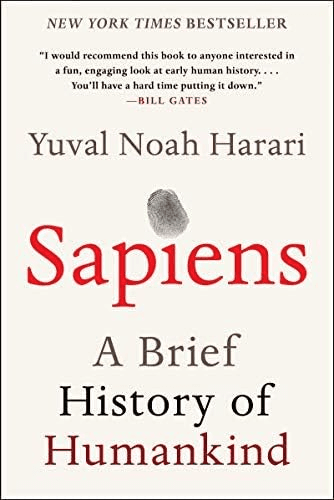
Sapiens. A book full of contradictions. Readable yet too long. Interesting, yet also boring. Razor sharp at times, but at other times subscribing to the same banal narrative.
Truth be told, I don’t have a straight recommendation for you. The Chronicle of Higher Education said of this book: “Reading Sapiens is like joining a wide-ranging and provocative dinner-table conversation. You may not agree with it all, but it makes for a memorable meal.” I have a love-hate relationship with the book, but to judge it fairly, we’ll pretend it’s a dinner-party conversation, with Harari as the intelligent guest who loves giving their opinion (Every party has one of those).
First, I love Sapiens because of its readability. Too many history books are boring, dense, and overstuffed with information, but that wasn’t an issue with Sapiens. Moving back to the comparison, the book reminded me of a conversation—intelligent, but never too hard for the reader to understand.
Not only that, but like any good discussion, it had some particularly insightful pockets. For example, Harari discusses the US Constitution in the book. The Constitution states that “All men are created equal.” The concept of “all men being equal” had been drilled into me at school, and, like all the kids in my class, I fervently believed it. But, Harari challenges, were all men created equal? Were all men created unequal (as ancient Babylonian society would have you believe)? No, says Harari. These were just creation myths to hold a particular society together, depending on how they chose to structure themselves. If you think about it, humans were just created. The concept of “equality” was dreamed up by our leaders.
“All men are created equal” is propaganda! I remember closing the book, because I couldn’t believe what I was reading. These are the best parts of any conversation. Somebody says something that makes us uncomfortable—but also makes us think.
But just because you love giving your discourses at a dinner party doesn’t mean all of them are necessarily correct or make sense. Herein lies Sapiens’s problem. A lot of the book is Harari sounding less like an intellectual and more like a disgruntled guest. It’s not anything new, though. Sapiens, in fact forms a predictable narrative.
Section one: We were happy hunter-gatherers, who, after hunting and gathering, hung out with each other near the fire. Life was great! Our bodies were perfectly adapted to this lifestyle, and we could have gone on living like this forever. What went wrong?
Section two: Whoops! What a bummer. We accidentally handed away our freedom to agriculture. Now we are forced to grow wheat in the blazing sun instead of frolicking through the forest like we used to. Not only that, but we can’t even enjoy the fruits of our labor. We have to hand them over to an evil emperor. Oh, the misery!
Section three: The Industrial Revolution rolls around, and with it, the state and the market (who Harari calls “the mother and father of the individual”) Enter the modern age, when the state and the market are great and we are all indulgent consumers.
As a fifth-grader, I thought this was groundbreaking. But after reading more, I now realize that this is an oversimplification. First of all, (as I will discuss in the Dawn of Everything recommendation) humans didn’t mechanically switch from being idyllic hunter-gatherers to miserable farmers. The reality, depending on region to region, is far more complex, with many different types of foraging societies. I’m not saying that Harari’s narrative isn’t true. Some part of it may well be. However, it seems to be more nuanced than what he suggests. Furthermore, towards the end of the book, Harari seems to be blaming the individual and sneaking in praises of capitalism and the government wherever he can.
Of course, this isn’t the entirety of the book. Sapiens has a number of ideas—about feminism, race, money, science, and a whole host of things. It’s definitely worth reading. But at its core, Sapiens is a jumble of interesting dinner-party ideas, some of which should be taken with a pinch (or perhaps a handful) of salt.